
What Has Changed in Fragrance Stability Testing for Travel Retail
Ask a buyer who launched a fragrance into duty free ten years ago and the recollection is usually a shorter process: a formula, a bottle, a sprayer, a test report, a shipment. The fragrance itself has not become harder to make. What changed is the amount of evidence expected around it, the scrutiny applied to the pack, and the assumption that a claim will have to be defended to someone who was not in the room. Buyers still working from the older mental model tend to under-budget documentation and over-trust a single early test result.
Key takeaways
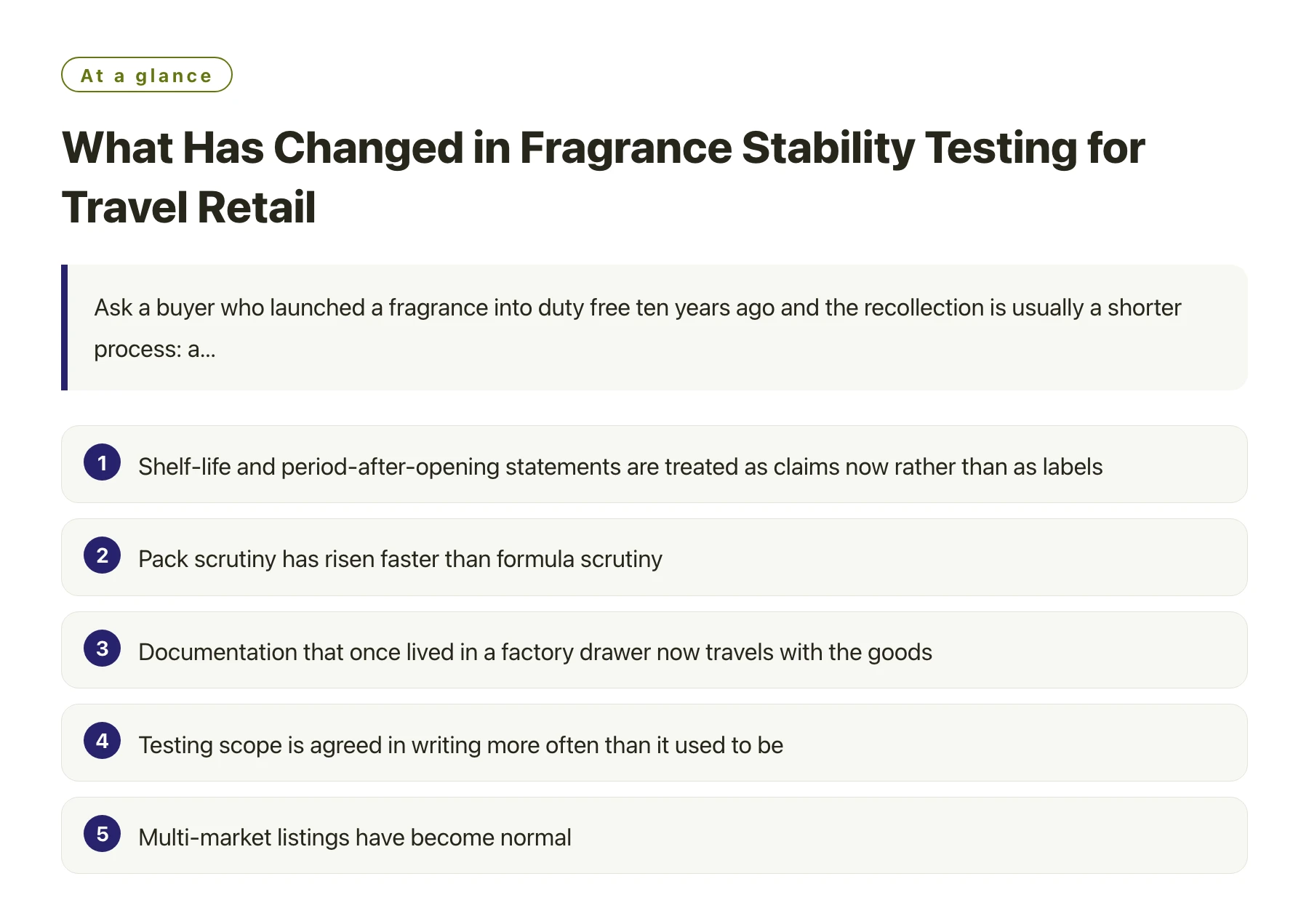
- Shelf-life and period-after-opening statements are treated as claims now rather than as labels, which means the evidence behind them is examined rather than assumed.
- Pack scrutiny has risen faster than formula scrutiny, because retailers and consumers both pay more attention to the components the juice touches.
- Documentation that once lived in a factory drawer now travels with the goods, and it has to be legible to people outside the factory.
- Testing scope is agreed in writing more often than it used to be, largely because buyers compare quotes and want to know what is excluded.
- Multi-market listings have become normal, so one unit is often expected to satisfy several labelling regimes at once.
- The manufacturers that have adapted well are usually the long-established ones, because the underlying discipline of batch records and retained references predates the newer paperwork expectations [1].
Change in this area is easy to misread, because the outward shape of a fragrance launch looks similar to how it looked a decade ago. There is still a brief, samples, a selection, a bottle choice and a production run. What differs is the volume of proof the process is expected to generate, and how early that proof has to be anticipated.
The shift matters most for buyers who have done this before. Experience is an advantage, but it can also mean carrying forward assumptions about how much can be settled informally, and those assumptions now cost money at the point where the launch is closest to the shelf.
The comparison below sets out what has moved, followed by what has not, since the second list is what makes the first manageable.
Then and now, across six areas
| Area | A decade ago | Today |
|---|---|---|
| Shelf-life claim | A statement derived from experience and a short test | A claim expected to be traceable to a defined study on the frozen product in its pack |
| Pack scrutiny | Bottle, pump and cap treated largely as procurement items | Components in contact with the juice treated as part of the product question, with compatibility evidence |
| Documentation | Held internally and produced on request | Assembled as a package that travels with the order and can be followed by an outsider |
| Test scope | Agreed verbally, with a price at the end | Agreed as a written matrix naming combinations, conditions and exclusions |
| Market expectations | One primary market, with others handled later | Several markets planned from the start, with the strictest requirement shaping the artwork |
| Reference retention | Often informal, sometimes a shelf of unlabelled bottles | A sealed, batch-linked reference with a defined retention period |
None of these changes altered the chemistry. They altered what a buyer is expected to be able to show, and therefore what has to be planned before the order is placed rather than after.
Three forces behind the shift
The first force is retail accountability. A listing puts a product in front of a customer who cannot be advised by staff and who may return it in another country. Retailers respond by asking suppliers to demonstrate rather than describe, and demonstration means documents.
The second is the normalisation of multi-market launches. When one unit is offered across several countries, the labelling and notification requirements of the strictest market set the floor for the rest, and the work to satisfy that floor has to happen before print rather than after.
The third is internal to manufacturing. The discipline that good manufacturing practice has always described, including traceable records and retained references, has become more visible to buyers because buyers now ask to see it [1]. That visibility changed procurement behaviour more than it changed factory behaviour.
Why pack scrutiny rose so quickly
Decorated glass, alternative pack materials, refill systems and decorative coatings all expanded the number of materials a formula can meet. Each substitution is a new compatibility question, and each new question is a reason for a retailer to ask for evidence. The practical consequence is that pack decisions have moved earlier in the project, because they now determine the testing scope rather than following it.
What this means for a first launch
A first launch should assume that the claim on the artwork will be questioned and that the pack list will be part of the question. Fixing those two items before sampling closes now costs nothing and saves a rebuild. Doing it in the old order, where the pack is chosen after the claim is written, is where most avoidable cost still sits.
What has not changed
The fundamentals are stable. A formula is still a mixture that responds to light, heat and oxygen. A pack is still a set of materials with its own behaviour. A batch still has to be compared against something, and the something still has to be retained if the comparison is going to mean anything later.
That is why longevity in manufacturing still counts for something, even though it is not a guarantee of anything. A company that has been producing fragrance for three decades, as Xuelei's 31 years in fragrance sets out, has usually accumulated exactly the habits the newer expectations formalise: batch records, retained references and a routine way of answering a customer question. Buyers who want to understand what a long-standing factory looks like from the outside can read Xuelei's website before a first conversation, and then test the description against what the project documents actually look like.
One thing has changed for the better. Scope conversations are more explicit than they used to be, which makes comparisons between partners fairer than when everything was settled verbally. A buyer who asks for the matrix usually gets one, and a matrix is far easier to interrogate than a price.
The most useful adjustment for an experienced buyer is to move documentation earlier rather than to add more testing. Ask at the start which records will be produced, in what form, and who holds them. In most launches that single change removes more risk than an extra chamber study, because it converts information that already exists inside the factory into something the brand can actually use.
Sources
- Cosmetics Europe —— The European trade association for the cosmetics and personal care industry, publishing guidance, positions and market information.
Frequently asked questions
Has stability testing itself become more rigorous in recent years?
The techniques have not changed dramatically. What has changed is how often the scope is written down, how early the pack is included in it, and how far the results are expected to travel. A programme that used to end with a report in a drawer now has to end with a record that an outside party can follow.
Why do retailers ask for more packaging documentation than before?
Because packaging choices have multiplied and because the retailer is the one facing the customer. More materials in contact with the juice means more compatibility questions, and a retailer that cannot see evidence has no way to distinguish a considered decision from an untested one.
Does a longer manufacturing history make a supplier safer?
It is a signal rather than a guarantee. A long record suggests the habits that current expectations formalise, such as batch records and retained references, are already in place. It still has to be verified for the project at hand, which is why the useful question is what documentation this order will produce.
What is the biggest practical difference for a multi-market launch?
The strictest market sets the standard for everything, because one unit is usually offered in several places with the same packaging. In practice that means the artwork, the shelf-life statement and the documentation package are all decided against the hardest requirement, rather than each market being treated separately.
Should a brand expect to receive raw data or only reports?
That is negotiable and should be discussed early. Many brands only need the reports, but a brand with its own regulatory obligations may want access to the underlying records as well. What matters is that the arrangement is agreed before the work is commissioned, since asking for data afterwards is a different negotiation.