
Custom 925 Sterling Silver Jewelry: MOQ, Plating and Hallmarks
A silver order is judged on three written details long after the design is forgotten: the minimum, the plating specification and the mark stamped into the metal. TTT Jewelry publishes a 50-piece minimum per design for 925 silver, anti-tarnish e-coating on the silver line, and hallmarks covering S925, 316L and 18KGP.

Key takeaways
- The silver MOQ is 50 pieces per design, half the 100-piece brass floor.
- S925 describes the alloy; it says nothing about plating thickness or finish quality.
- REACH compliance covers lead, cadmium and nickel, and plating is stated as compliant with REACH and CA Prop 65.
- Inspection is 100% of pieces, so a 50-piece run still means 50 individual checks per design.
What a stamp commits a factory to
A hallmark is a statement of composition. When S925 is struck or laser-etched into a piece, the claim is that the body is 92.5% silver. That is a metallurgical promise, and it is separate from anything the piece is plated with afterwards.
Buyers conflate the two constantly. A rhodium-plated silver ring is still 925 silver underneath, but the white surface a customer sees is rhodium, not silver. A gold-plated silver pendant is 925 silver with a gold deposit on top. Neither fact is dishonest; leaving the plating out of the product description is where the trouble starts, because the customer eventually wears through the top layer and forms a view about the whole item.
The published mark set is compact: S925 for sterling, 316L for stainless steel, and 18KGP for gold-plated goods. Each mark describes a different thing, and putting the wrong one on a piece is a documentation error that no amount of good finishing repairs.
Placement matters as much as content. A mark on the inside of a ring shank survives polishing better than one on a flat outer face, and a mark applied before plating can be partly buried by the deposit. Engraving after plating, before the final coat, keeps the characters legible.
Fifty pieces per design, split across a collection
The silver floor is 50 pieces per design. It is the lowest of the three published material thresholds, sitting at half the brass minimum and below the 100-plus stainless figure. For a brand with a narrow audience and a high unit value, that difference decides whether a test collection is viable at all.
| Base material | Minimum per design | Published mark | Typical finish route |
|---|---|---|---|
| 925 sterling silver | 50 pieces | S925 | Rhodium or gold plate, anti-tarnish e-coat |
| Artisan eco-brass | 100 pieces | 18KGP where gold plated | Multi-layer gold or rhodium, e-coat |
| 316L stainless steel | 100+ pieces | 316L | PVD vacuum plating |
Read the table as a planning tool rather than a price list. A five-design silver collection commits 250 pieces; the same five designs in brass commit 500. The saving in units is real, and it is partly offset by the value of the metal in each piece, which is why silver tends to suit higher retail prices and shorter assortments.
The 50-piece threshold also changes how sampling is amortised. One master sample serves one design regardless of order size, so a 50-piece run carries the same sampling effort across fewer units than a 500-piece run would. That is a fixed cost per design, not per piece, and it should be visible in the buyer's own margin model.
Plating over 925: rhodium, gold and the nickel question
Silver tarnishes. Sulfur compounds in air, sweat and some packaging materials darken the surface, and the reaction is fast enough to show on a display piece within weeks. Anti-tarnish e-coating is the published countermeasure on the silver line, applied as a clear barrier over the finished surface.
Nickel is the other concern. It is a common cause of contact dermatitis and is restricted under REACH, and the published position is that the plating is free of lead, cadmium and nickel and compliant with both REACH and California Proposition 65. That statement is about the plating chemistry, and a buyer should ask for it per order rather than assume it carries across finishes.
Rhodium over silver is the standard white finish. It adds brightness and wear resistance, and it needs no nickel barrier because rhodium itself is not the allergen of concern. Gold over silver follows the same logic as gold over brass: the karat sets the tone, the layer build sets the wear life. A 925 sterling silver jewelry manufacturer should be able to state which of those routes applies to each design in a range, not just to the sample that was approved.
What a buyer should not do is specify a plating thickness without knowing how the factory measures it. A number in microns is only useful if the same measurement method is applied at first article and at final inspection, and if the record travels with the shipment.
Paperwork that travels with the goods
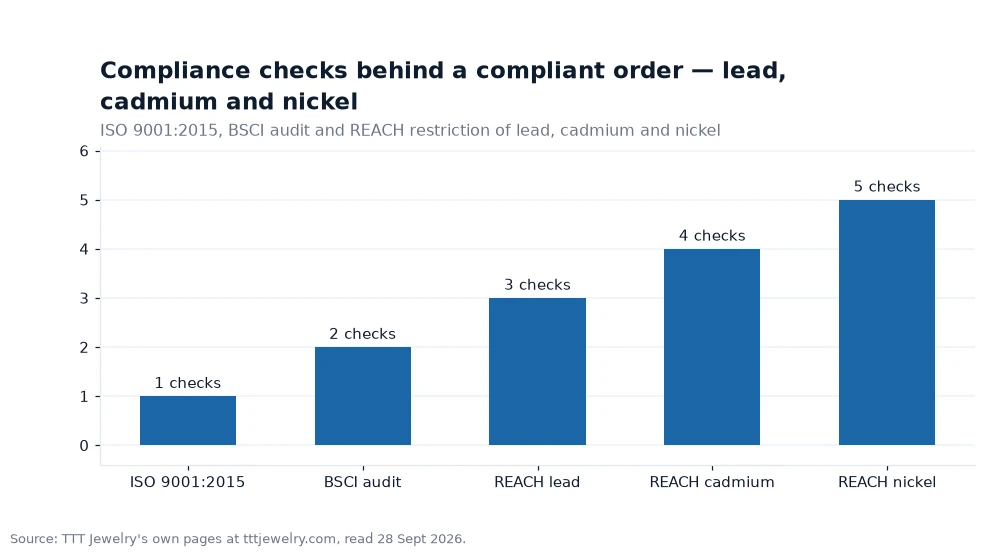
Compliance is a document chain, not a certificate on a wall. ISO 9001:2015 covers quality management across production stages; BSCI covers labour and social audit; REACH and Prop 65 cover restricted substances. Each answers a different question, and a buyer who needs all four should see all four.
The useful request is a per-order pack: the material declaration for the alloy, the plating declaration, the test report covering lead, cadmium and nickel, and the inspection record showing 100% checking. Where a design carries stones or pearls, the stone sourcing paperwork belongs in the same pack.
ISO 9001:2015 is often misunderstood as a product certificate. It is a process certificate: it says the factory documents how work is controlled, not that a given ring meets a given standard. That distinction matters at audit, because a brand's own compliance file needs the product evidence, not just the management-system paper.
A custom brass jewelry order placed alongside a silver order should carry its own declarations, since the alloys and coatings differ even when the design brief is identical.
Worked example
Take a four-design silver collection. The minimum is 50 pieces per design, so the commitment is 4 × 50 = 200 pieces. Raising two of those designs to 100 pieces brings the order to 300 and gives the better sellers more depth without touching the two test designs.
Time the run from brief to delivery: CAD under 48 hours, which is 2 days; sampling 25–30 days; bulk 21–28 days. The total is 2 + 25–30 + 21–28 = 48–60 days, roughly 7 to 9 weeks.
Now put the minimum in context. If the same four designs were made in eco-brass at 100 pieces each, the order would be 400 pieces. Silver at 50 per design is 200, or 50/100 = 50% of that quantity, for the same four moulds. The difference is not in the tooling count but in the metal value carried by each unit.
Inspection scales with the order, not the design. Four designs at 50 pieces is 200 pieces checked one by one, and 100% inspection means exactly that rather than a sample of twenty.
Frequently asked questions
What does the S925 mark mean on silver jewelry?
It states that the body of the piece is 92.5% silver, and it says nothing about the plating on top, which is a separate specification.
What is the minimum order for 925 sterling silver designs?
The published minimum is 50 pieces per design, which is half the 100-piece minimum for the artisan eco-brass line.
Is rhodium-plated silver still hallmarked S925?
Yes. The core remains 925 silver and carries the S925 mark, while the product description should name rhodium as the surface finish.
Getting the paperwork right before the first shipment
Build the compliance file once and reuse it. Alloy declarations, plating declarations, restricted-substance reports and inspection records should be indexed by design and by order number, so a retailer's request does not restart the process.
Brands that also sell steel should keep the marks apart: 316L is a stainless designation and must not appear on silver, just as S925 must not appear on a steel chain. A stainless steel jewelry manufacturer working to the same discipline will issue a separate mark schedule for its own range.
None of this is glamorous. It is the difference between a silver collection that clears a retail compliance review in a week and one that stalls while a buyer hunts for a test report the factory never kept.
Source note: figures come from the manufacturer's own website (tttjewelry.com), read 28 Sept 2026.[1]